Main project · Hierarchical Additive Mass-Injection Bias · Qwen3.8-27B on A100, Sep 2026
HAMIB
67% of the facts for 6.3× less GPU energy. A reader model was shown only a 32,000-token correlation diagram of a 4-hour agent session and none of the 179,394-token transcript. It answered 63 of 96 questions using 0.99 MJ. The same reader given the full transcript answered 94 using 6.28 MJ.
Python · PyTorch · Qwen3.8-27B bf16 · A100 80 GB · 96 questions · greedy decoding
Result
6.3×
less GPU energy for the whole run, diagram build included
63 / 96
correct from the 32k diagram alone, no transcript shown
94 / 96
correct from the full 179,394-token transcript
12%
of the baseline's total FLOPs for 67% of its answers
Recall vs. energy
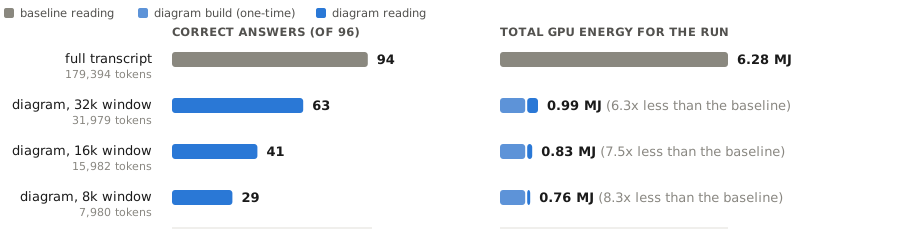
The diagram is built once per session. The build took 1 h 45 min and 0.69 MJ, most of every blue bar. The build cost does not grow with the number of questions. Below 11 questions the diagram uses more energy than the full transcript, at 96 it uses 6.3× less, and at 1,000 the saving reaches 17×.
The external model that routed the build ran on a hosted API, so the bars do not include its energy. Its usage is published: 10,571 requests, 42.2M input and 9.8M output tokens.
Where the answers came from
All 56 recovered facts came from the diagram. The reader was never shown a verbatim round trip, yet it returned exact values from four hours earlier such as 4440, 1/110 and 2:1.
Most misses happened at reading time. Of the 30 facts that the full transcript got and the best diagram cell missed, the window budget evicted 1 and the build never extracted 4. The other 25 were in the window, and the reader did not use them. The weak point is the reader's use of dense summaries.
The reader did not fabricate answers when the window shrank. For the 8 questions with no answer in the corpus, the reader answered “unknown” 8/8 at 8k and 16k, and 7/8 at 32k.
Accuracy grid
Correct answers out of 96 by context window and bias strength w. All of the effect comes from narrowing the context, and the bias adds none. The outputs at w = 0 and w = 0.1 are byte-identical at every window size, and larger w only lowers the score.
| window | w = 0 | w = 0.1 | w = 0.3 | w = 1.0 |
|---|---|---|---|---|
| 32,000 | 63 | 63 | 58 | 27 |
| 16,000 | 41 | 41 | 33 | 20 |
| 8,000 | 29 | 29 | 24 | 18 |
| full transcript (179,394) | 94 |
What this run does not show
The diagram does not match the full transcript. The full transcript scores higher than every cell (McNemar one-sided p < 1e-9; 95% CI of the pass-rate difference for the best cell [−0.42, −0.23]). This run does not demonstrate equal recall at lower compute.
The attention bias did not work in this run. Two configuration defects explain the null result. First, the injected mass was the raw, uncapped satellite count (0 to 43, so w = 1.0 adds up to +43 to a pre-softmax logit). Second, the bias targeted planet nodes while 74 of the 88 facts were stored in satellite nodes. The code has a planet-plus-satellites switch, but this run never used it.
Earlier results (May 2026)
These results measure the joint effect of the diagram and the bias. They were measured before the fixes for the attention-path defects found in the 2026-09 code review, so they will not reproduce exactly on current code.
| experiment | setup | baseline | HAMIB | result |
|---|---|---|---|---|
| LongMemEval accuracy | Llama 3.3 70B, N = 500, paired, blinded judge | 0.234 | 0.306 | 1.31×, McNemar p = 0.0037; reproduced with a second judge at 1.31× |
| OOM rescue | GPT-OSS-20B on a 24 GB GPU, N = 25 | 0 / 25 (out of memory) | 22 / 25 | a 20B model runs in 24 GB by compressing context into the diagram |
| Latency | Llama 3.3 70B, synthetic benchmark | p50 12.7 s / p95 22.3 s | p50 5.6 s / p95 6.2 s | 2.26× / 3.61× faster |
How it works
HAMIB parses dialogue into a three-tier correlation diagram of sun nodes (top-level topics), planet nodes (distinct facts under a sun) and satellite nodes (concrete details under a planet). Each planet carries a mass equal to the number of satellites attached to it, so a topic with more details carries more mass.
HAMIB gives the reader a budgeted window of the diagram instead of the transcript. Optionally, HAMIB adds the mass to the pre-softmax attention logits, Softmax(QKᵀ / √d + w·M) V. This addition works as a patch on any existing Transformer with no retraining. The 2026-09 run is the first run that measures these two parts separately.
Reproducing it
Anyone can re-score the run without a GPU from the 159 raw files with checksums in the repository. The frozen design contract, the decision ledger recording every deviation, the redacted corpus, the 96 questions and the per-question records are all under benchmark/mcbuild_bench.
Technical report
Kawai, R. (2026). Geometric Convergence for Conversational Context Management: A Distributed Structured Memory Architecture Based on Correlation-Diagram Data. Zenodo, doi:10.5281/zenodo.19354705.